Yangon Post

A History of Egg Cups
Palaeolithic Protein, Pompeii and dippy eggs for The People Did you know we've been eating eggs for over two million years? Cave paintings from the Palaeolithic era tell us that eggs were a key part of the hunter-gatherer diet. Hieroglyphics and tomb paintings from Ancient Egypt show eggs being stored and eaten. And Horace tells us that Roman meals progressed "ab ovo usque ad mala" - "from the egg to the apples". But what about Egg Cups? When did we stop scooping out the protein for survival, and start putting them on tiny thrones? Silver egg cups were dug up at Pompeii so we know the Romans were at it. They pop up in Dutch Old Master pictures of lavish banquets, and Louis XV had a very ornate porcelain set; delicate, ornate egg cups have been on the tables of wealthy homes for a long time. Leap forward to today and we eat about 7.2 million boiled eggs a day in the UK. That's a lot of egg cup action. This started with the industrial revolution which enabled mass-produced porcelain and wood-turning, making affordable egg cups available to the middle-classes. With this came access to the soft-boiled egg for all: you can't hand-peel a soft-boiled egg, so pre-egg cups, you had to have them hard-boiled, scrambled or fried. But with your egg propped up, you can indulge in a gooey yoke, or dip away with your soldiers, something which had been the preserve of the aristocracy until that point. So when designing a Kalinko egg cup, which should it be? An opulent throne for the most perfect edible form that exists in nature? Or something that speaks of utility and simple pleasures? We couldn't decide, so we made both. A baby golden goblet for your dippy egg, and an antiqued version which feels like it has come off a 16th century ironmonger's workbench. We also made them adorable matching spoons, because why not? They're here in time for Easter, but in our house, they're here for every day, because it's sometimes the smallest things which spark the greatest joy, and this is one of those times. Shop Egg Cups
Learn more
The Yangon Post: Issue 5
Did you know that the Burmese are more into tea than we are? Or that our furniture is made from old Burmese buildings? Or that there are 3000 miles of un-mapped railways in Burma leading to mystery destinations? Read all about it in the latest issue of The Yangon Post, our in-house newspaper which comes home with every order.
Learn more
In praise of the Burmese Teashop
You’ll know when you see one: chaotic and bustling, with full grown adults sitting on tiny child-sized stools at knee-high tables, deep in conversation or hidden behind newspapers. The clientele is mostly men, their wide-splayed legs ending in smart velvet flip flops, or children gorging on long doughnuts dipped in honey, heading for a sugar high. Beneath the din of crashing pots and pans and hollers from the kitchen, gossip is shared, serious business is plotted and historically, the seeds of uprising are planted in muted voices over hot sweet tea and noodles.
Learn more
Our favourite Burmese salads
If you'd like to wow your guests, or perhaps just your own taste buds, here are two of my favourite Burmese salads. The recipes come from the Rangoon Sisters, and where lots of Burmese recipes rely on ingredients which are hard to find in the UK, the below salads are very easy to make with nothing that Tesco can't provide. All you need is a sharp knife. Enjoy!
Learn more
Meet the Rangoon Sisters!
We introduced you to these guys back in the summer, when salads were on the mind. Well, here we are in deepest winter and they're BACK to take you to Burma in your minds, and through your taste buds. A quick reminder...Amy and Emily are "two greedy sisters cooking traditional Burmese food". Obviously, we have a lot in common. They were born and bred in England but have Burmese heritage and have been wowing the crowds across London with their supper clubs for years (pre-covid), and since last Spring with their eponymous cook book. And lucky us, because they have indulged Sophie with lots of greedy questions. Here goes...
Learn more
Burmese Salads to Shake Up Your Summer
This is Amy and Emily Chung, and they are the Rangoon Sisters. They call themselves "two greedy sisters cooking traditional Burmese food"... our kind of people! Born and bred in England but with Burmese heritage, their incredibly popular supper club has been giving London an introduction to Burmese food since 2013. Now we can all gorge on their phenomenal nosh from home thanks to their brand new eponymous cookbook.
Learn more
Kalinko Living: Meet MiMi Aye
We’ve written about Burmese food before, and chatted about where to try it in London. But there’s never been an easy for us to help you try it out at home….until now! Chef and author MiMi Aye, who was British-born to Burmese parents, released her book MANDALAY: Recipes & Tales from a Burmese Kitchen last Summer, and has made seismic steps for Burmese food in kitchens beyond Burma. She agreed to chat to us and tell us all about why her book has been so successful, what Burmese food really is, and how it has defined her life.
Learn more
Kalinko Living: A Burmese Breakfast
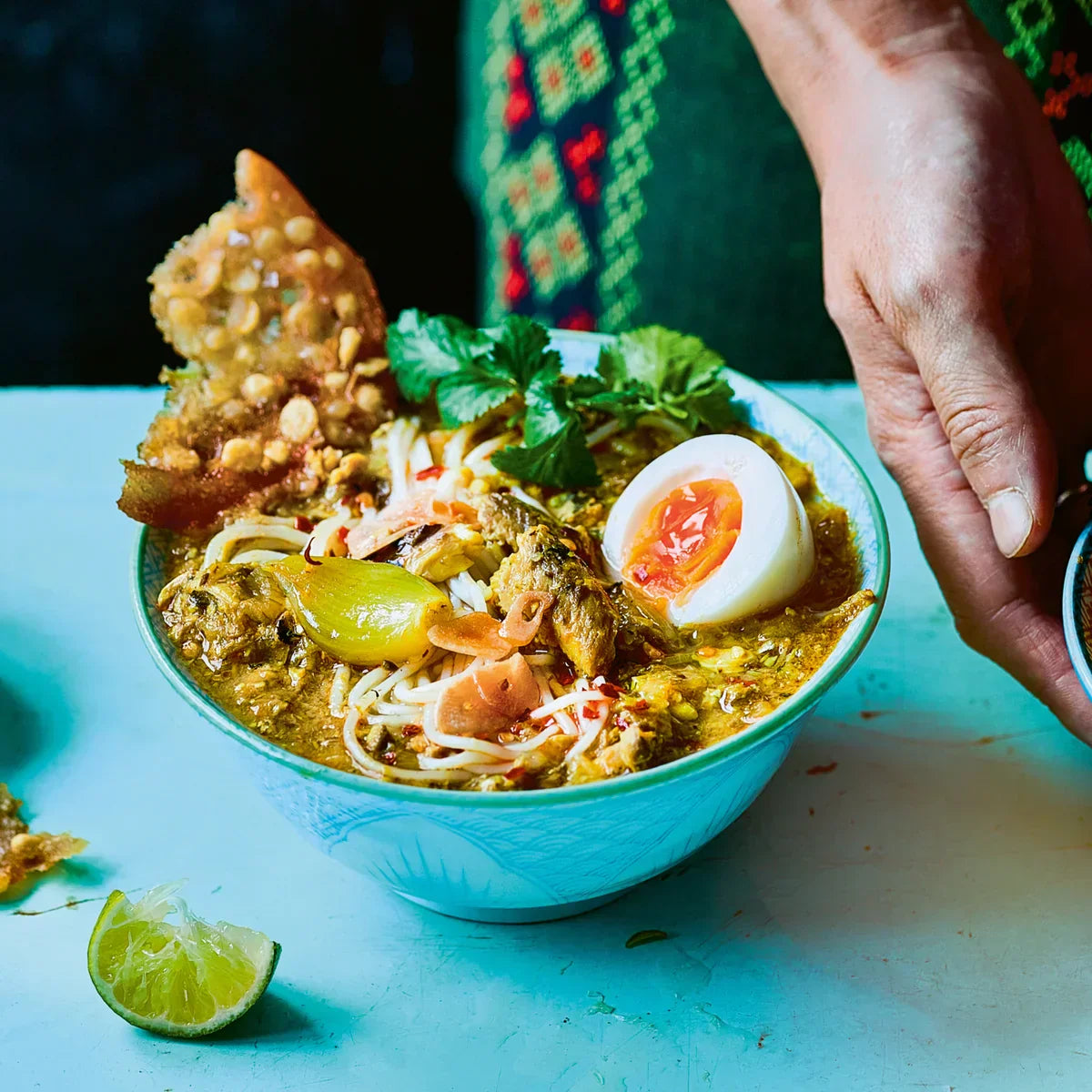
Mohinga (pronounced exactly as it’s spelt), is the national dish of Burma. It’s really a breakfast dish, but people eat it all day long. There are quite a few ingredients, but don’t be put off… it actually isn’t that difficult, and it’s delicious. It’s also an excuse to explore an Asian supermarket. Let’s get fishy….
Learn more
Burma Calling: London's Lahpet
Burmese food is the most underrated cuisine in Asia. Just like the country, it’s incredibly varied and colourful, rammed with textures and flavours, and has a sweet, salty, sour spiciness that will knock your flip flops off.
Learn more